



Read Time 5 Minutes
If you’ve ever watched a pianist sit down with a piece of sheet music they’ve never seen and play it clean the first time, you might have wondered why guitarists seem to struggle so much more with the same skill. It’s not a matter of intelligence or dedication. The guitar has a structural quirk that makes sight reading genuinely, technically harder than almost any other instrument — and until you understand why, the usual advice of “just practice more” doesn’t get you very far.
The Core Problem: One Note, Five Locations
On a piano, middle C is one key. It sits in one place. You see it on the staff, your hand goes to the key, done.
On a standard-tuned guitar, middle C (C4) can be played at:
- The 8th fret of the low E string
- The 3rd fret of the A string
- The 10th fret of the D string
- The 5th fret of the G string
- The 1st fret of the B string
That’s five different physical locations producing the same pitch. No other common instrument in Western music has this problem to this degree. Horn players have one fingering per note. Violinists have limited position options. Pianists have exactly one choice.
When you’re sight reading, your brain has to process rhythm, pitch, dynamics, articulation, and phrasing all at once — in real time. On guitar, it has to do all of that while also deciding which of several physical locations to use. That’s a significant extra cognitive load, and it’s the root of why guitarists who are otherwise skilled players freeze up when handed a chart.
The Solution: Position Lock
The single most effective thing you can do for your sight reading is to commit to a position before you start playing and stay in it as long as musically possible.
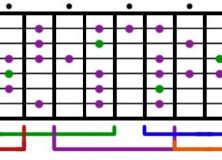
A “position” on guitar refers to a four-fret window on the neck. In 5th position, your index finger covers the 5th fret, middle covers the 6th, ring covers the 7th, and pinky covers the 8th. Every note gets exactly one location within that window — the decision is already made.
When you’re reading through a chart and you have a few seconds to look ahead, your first thought should be: what position covers most of these notes? Pick it, lock in, and stop reconsidering.
This is how professional session players and orchestral guitarists approach reading. They’re not hunting for the “best” fingering in real time — they’ve pre-committed to a position and they play through it, adjusting only when the music clearly demands a shift.
How to Practice Position Lock
Pick a simple melody you already know — “Happy Birthday,” a folk tune, anything familiar. Write out the notation (or use sheet music you already have). Now play it entirely in one position, even if it feels awkward. Then play it in a different position. You’re training your eyes and fingers to see the fretboard as a set of windows rather than a map of individual notes.
Train Rhythm and Pitch Separately
Most people try to sight read by processing rhythm and pitch simultaneously. That’s actually two difficult cognitive tasks running in parallel, and when you’re a beginner at reading, it’s too much.
The fix is simple: separate them deliberately.
Step 1: Clap or tap the rhythm only. Look at the staff and ignore the pitches entirely. Just clap the rhythm. Do this until it’s solid.
Step 2: Play the pitches in free time. Forget about rhythm. Just slowly find each note in order, getting your fingers to the right places.
Step 3: Put them together.
This sounds almost too simple, but it works because it respects the actual cognitive load involved. Most sight reading problems are rhythm problems, not pitch problems — players will often know where the notes are but lose the beat because they’re spending mental energy on finding the notes.
Isolating rhythm also forces you to confront the real source of most reading struggles: dotted rhythms, syncopation, and ties across barlines. Those will trip you up every time if you’re trying to process them simultaneously with unfamiliar pitches.
Bass Players: The Clef Transition
If you’re a guitarist who also plays bass, or a bassist who came up reading tabs, the first hurdle is simply that bass is notated in bass clef while most guitarists learned to read in treble clef.
Bass clef is not hard once you internalize it, but it requires deliberate practice because the note names don’t line up with what your treble clef brain expects. The lines in treble clef spell E G B D F (Every Good Boy Does Fine). Bass clef lines are G B D F A (Good Boys Do Fine Always).
The most common mistake is trying to mentally translate from treble clef. If you find yourself thinking “okay, that’s a D in treble, so in bass clef it must be…” — stop. That path is slow and error-prone. You want bass clef to be its own language, not a translation.
The fastest way to build bass clef fluency: flashcard drill the notes on lines and spaces until they’re automatic. Spend five minutes a day for two weeks. Don’t skip this; it’s the foundation everything else rests on.
Also worth noting: bass guitar sounds an octave lower than written. Standard bass notation is written in bass clef an octave higher than it sounds, which means the written range sits in a comfortable spot on the staff. This is intentional — it avoids excessive ledger lines — but it can be confusing if you’re thinking about absolute pitch.
The Lookout: Always Read Ahead
One habit separates decent sight readers from great ones: they’re never reading the note they’re playing. They’re always reading ahead.
When your eyes are on the note your fingers are currently executing, there’s no time to process what comes next. Good readers keep their eyes roughly one to two beats ahead of their hands at all times.
This feels unnatural at first because it’s tempting to look at what you’re doing. But your fingers already know where they’re going — you sent them there a beat ago. Trust them, and move your eyes forward.
Practice this consciously: as soon as you know what your hands are doing, force your eyes to the next note. Even if you’re reading slowly, maintain that gap. It’s a habit you build, not a talent you have.
Start Slow Enough to Be Perfect
The most common sight reading mistake is playing too fast. If you stumble on a passage, slow down until you don’t — even if that means a painfully slow tempo. Stumbling and pushing through teaches your brain to associate hesitation and uncertainty with reading. Playing slowly and cleanly teaches it to associate reading with control.
A useful rule: find the hardest passage in the piece first. Set your tempo to where you can play that passage cleanly. Then read the whole piece at that tempo. It feels humble, but it produces real progress.
The Big Picture
Sight reading on guitar and bass is a learnable skill, but it requires understanding the specific obstacles these instruments present. The multiple-position problem isn’t a flaw you work around — it’s something you design a strategy for, and that strategy is position lock. Rhythm and pitch confusion isn’t a general reading weakness — it’s a cognitive load problem you solve by isolating the two skills in practice.
Work these concepts consistently and you’ll find that reading becomes less like decoding and more like listening — the notes start to flow from the page through your hands with less and less friction in between.

)